We were lucky to have a presentation by guild member Shirley Rutherford this month on Kawandi style quilts. The history of Kawandi quilts is connected to the Siddi people, who are of African descent and migrated to India and Pakistan. The quilts resemble Crazy Quilts, but the method and construction sequence differ.
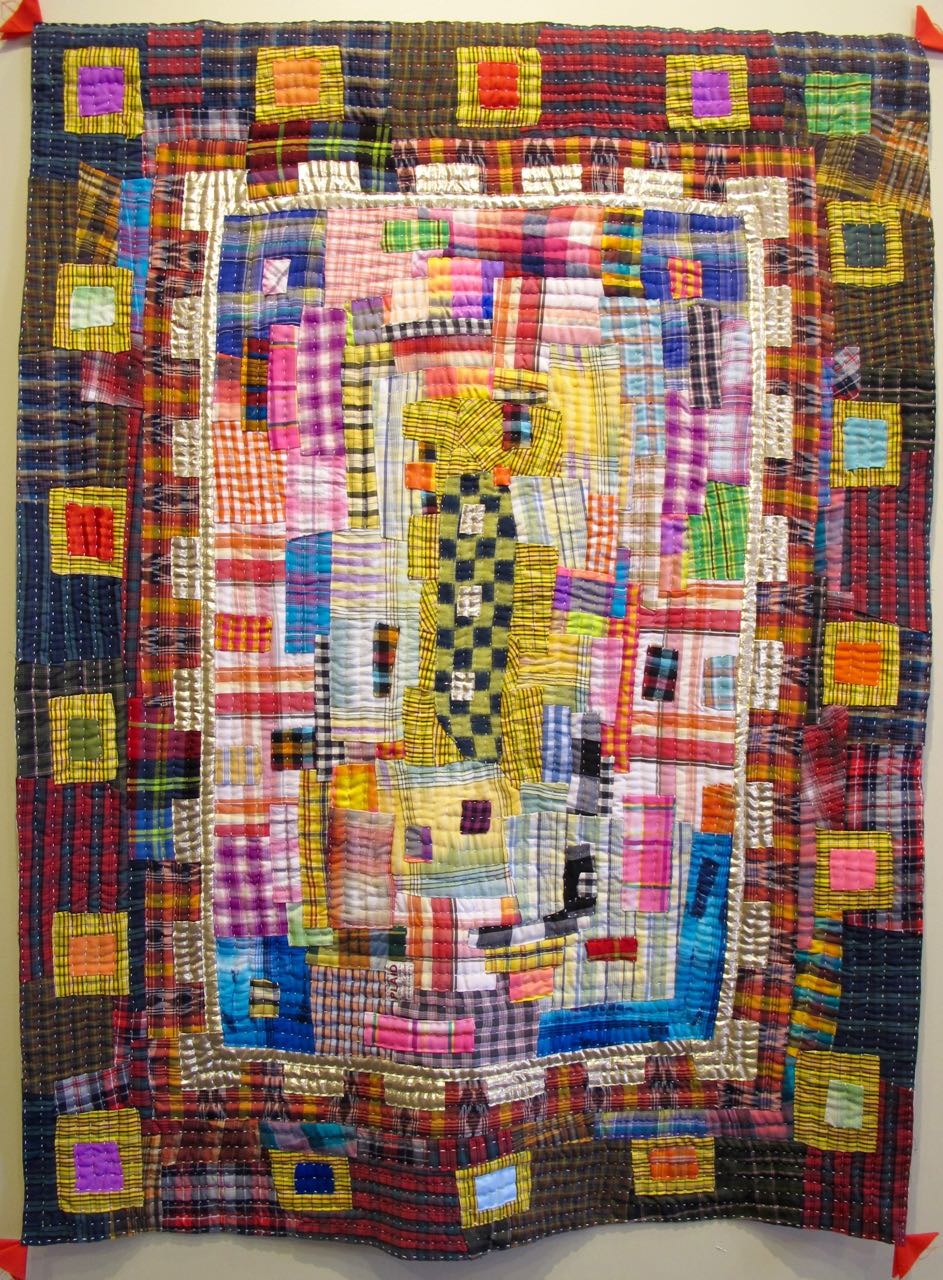
The Siddi people are descendants of Bantu peoples from Southeast Africa. Some were brought to India as slaves by Portuguese merchants and Arab traders, while others were imported as military mercenaries or sailors. The art of Kawandi quilting is practiced by elderly Siddi women who use scraps of fabric from their households to make colorful quilts. The quilts are used as mattresses and covers in Siddi households. Kawandi quilts are hand-stitched and assembled from the outside in. The edges are turned under and stitched together, and batting is laid inside. It is traditional to place a few grains of rice under the final piece of fabric to ensure that the recipient never goes hungry.
Shirley offered the following tips:
- Allow for 1/2″ folds on pieces and backing fabric;
- Start from the same edge as your dominant hand (right side for righties, left for lefties);
- Keep stitching rows about 1/2″ apart, but make sure to catch seams;
- Iron your scraps and make sure they are larger than 2″ in both directions – think larger than you need;
- Recommend using a solid backing fabric rather than piecing to avoid too many seams as there are many layers of fabric to sew through and some tightly woven fabrics are tougher to get through;
- Sew with crochet cotton, pearl cotton or embroidery floss (using at least 3-4 strands) – it will need to be strong to get through all that fabric. Try a long thin needle (a milliners 3 is good) and keep a pair of needle nosed pliers or some forceps handy to help pull the needle through.
Some resources to check out:
Kawandi Inspired Quilts by Margaret Fabrizio – a link to her Kawandi playlist
Dr. Henry Drewell – MOAD – Africans in India, Soulful Stitching
Antha Reddy – Reviving the Art of Siddi Quilts
Joe Cunningham interviews Margaret Fabrizio
Marion’s World – Kawandi: Tips and Tricks For Your First Quilt
Jeri Bellini – Ragged Edged Kawandi
Snowstorm Crafts – How to Hand Sew and Use Kawandi Quilting Techniques

 Squamish Quilters Guild